Jib Crane engineered for precise local lifting.
Compact, flexible and built for repetitive material handling where the load needs to move quickly around a defined workstation. Dhiraj Cranes offers Jib Cranes with 360° rotation, compact construction and application-specific customization.

 VIEW 01
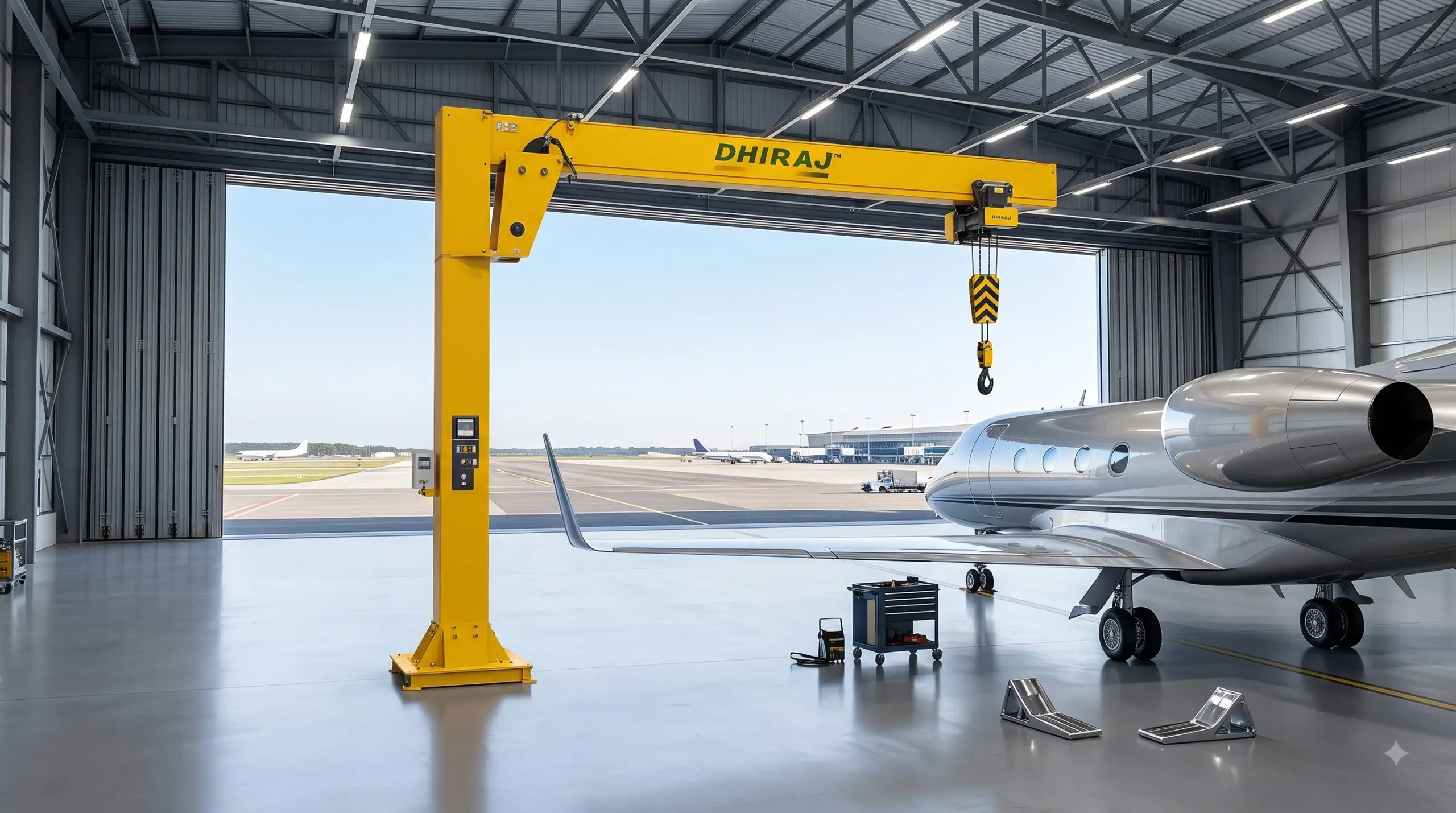 VIEW 02
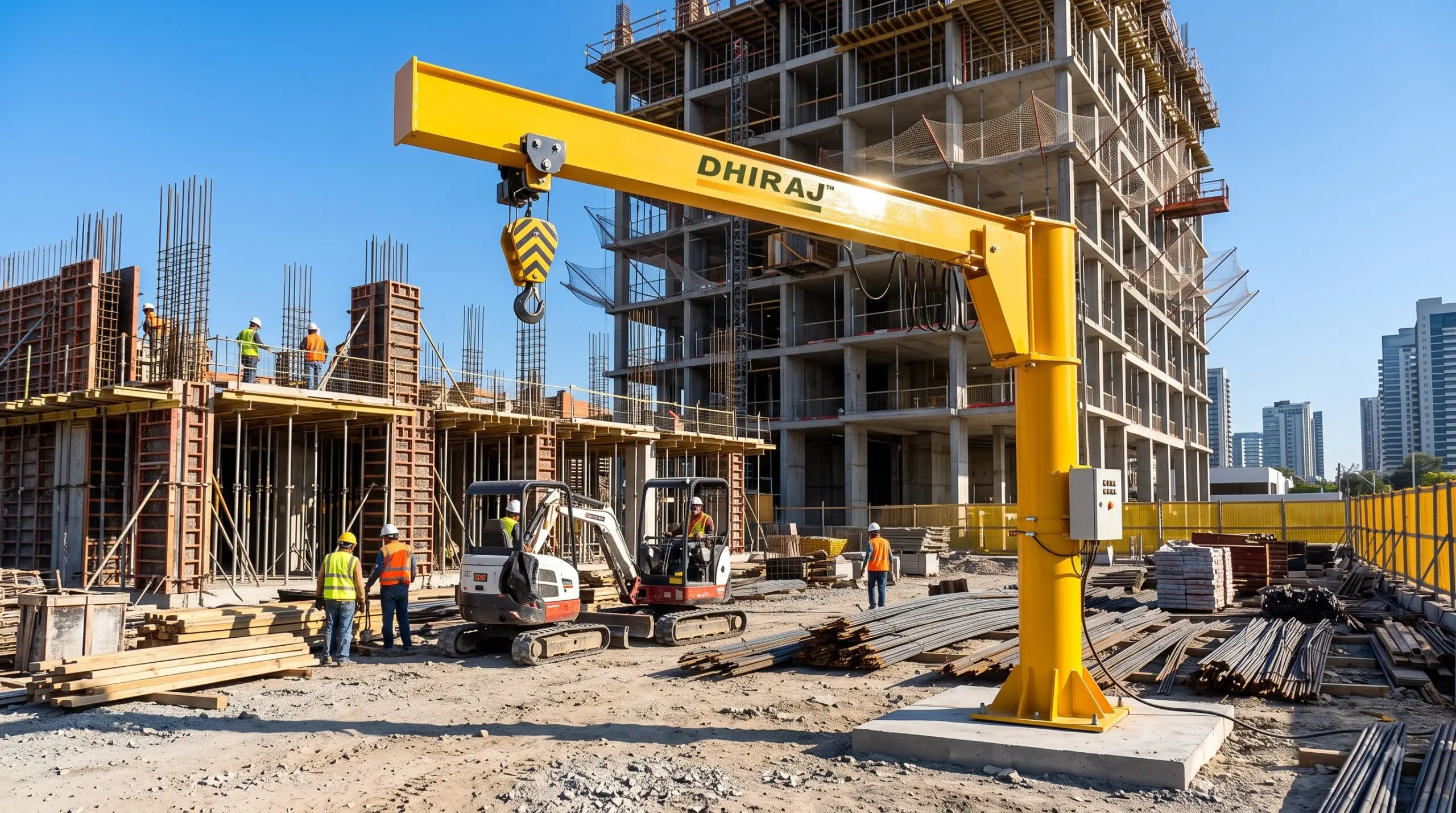 VIEW 03
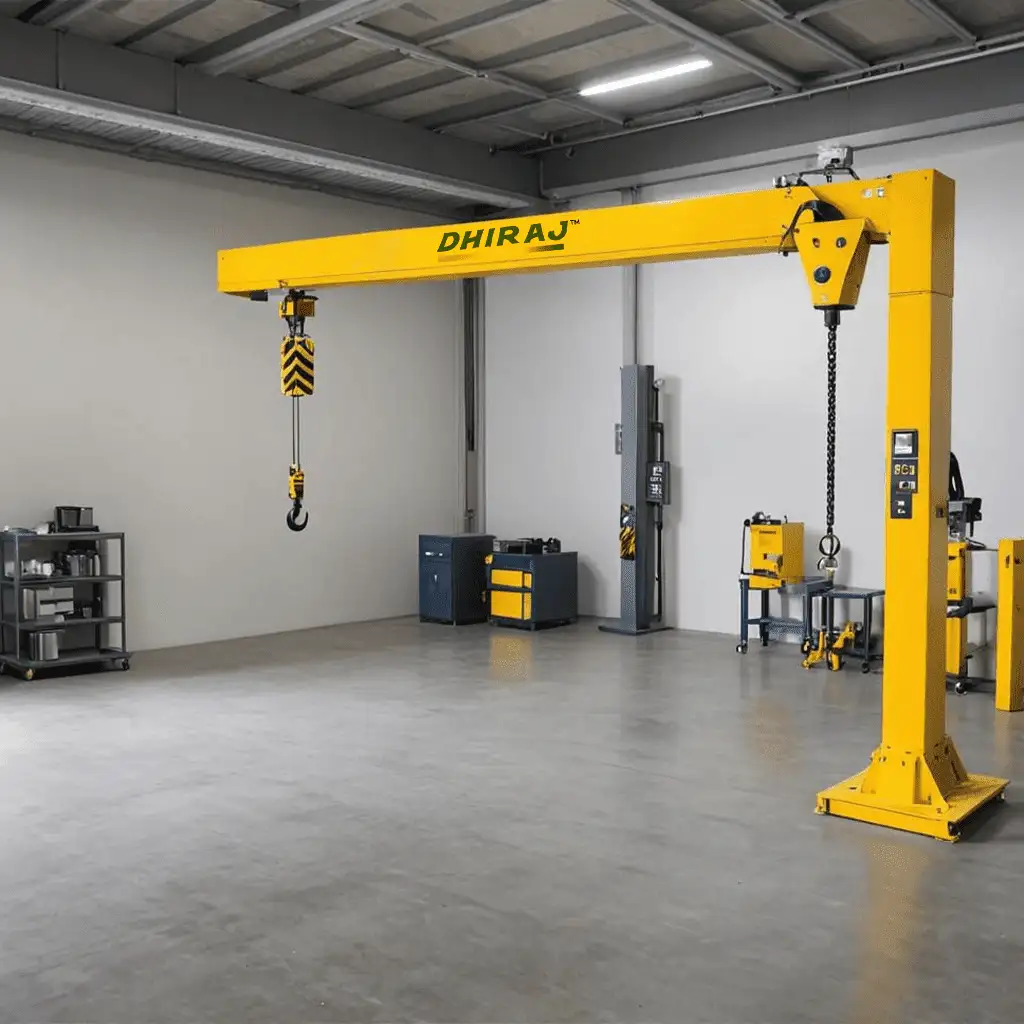 VIEW 04
Small footprint. Focused lifting. Better workstation flow.
A Jib Crane uses a horizontal arm to support and move a load around a defined working area. The Dhiraj product page specifies a lifting capacity of 0.25 T to 5 T and span/operation up to 6 meters, with 360-degree rotation and customizable configurations.
That makes the concept especially useful where material has to be lifted, positioned and transferred locally rather than moved across an entire factory bay. The compact architecture can complement larger overhead crane systems by taking care of repetitive workstation lifting tasks.
Dhiraj lists factories, warehouses, construction sites and workshops as application environments, with single-girder and double-girder variants available.
Designed around the point where lifting actually happens.
Instead of making a complete overhead runway responsible for every small lifting movement, a jib crane can provide a dedicated lifting zone around a workstation.
- Defined local lifting coverage
- 360° rotation for flexible positioning
- Compact and flexible arrangement
- Suitable for repetitive material handling
- Custom configuration based on requirements
Built for the moments that need control.
360° Working Area
The source product specification identifies 360-degree rotation, allowing the jib arm to position loads around its operating area.
Compact Architecture
A localized lifting system can fit naturally into workstations, workshops and areas where a full overhead system is not required for every task.
Application Flexibility
Dhiraj lists factories, warehouses, workshops and construction sites among the intended applications.
Custom Capacity
Capacity, span and other operating characteristics can be discussed around the actual application rather than forcing a one-size-fits-all arrangement.
Single or Double Girder
The current product information lists both single-girder and double-girder Jib Crane configurations.
Industrial Durability
Dhiraj describes its Jib Cranes as robust, durable and intended for demanding industrial material-handling environments.
Choose the configuration around the lifting duty.
Single Girder Jib Crane
Positioned by the source page as a solution for light to medium-duty applications. The compact configuration is intended to provide a practical, cost-effective local lifting arrangement.
Light / medium-duty focus →Double Girder Jib Crane
The source page describes the double-girder variant for heavier lifting tasks where additional strength and stability are required.
Higher-duty focus →Where localized lifting makes a difference.
The numbers at a glance.
These specifications follow the current Dhiraj Cranes Jib Crane product page. Final engineering values should be confirmed against the project requirement before manufacturing.
Application-first engineering
Capacity, span, maximum height, lifting speed and trolley arrangement can be considered around the actual operating requirement.
| Capacity Range | 0.25 T – 5 T |
|---|---|
| Span / Operation | Up to 6 meters |
| Maximum Height | Customizable based on application |
| Type | Single Girder / Double Girder |
| Rotation | 360-degree rotation |
| Material | Mild Steel / Stainless Steel |
| Color Options | Yellow / Red / Orange / Green |
| Lifting Speed | Customizable based on requirements |
| Trolley Option | With / Without Trolley |
| Application | Factories, Workshops, Warehouses, Construction Sites |
| Design | Compact, Flexible, Durable |
A clear project journey.
Understand load, working radius, height, duty and workspace.
Select the suitable jib arrangement and operating concept.
Develop the project-specific design around the application.
Fabricate and prepare the crane for the specified application.
Installation, commissioning and after-sales support can be discussed.
Designed around controlled material movement.
The current product information emphasizes durability, safety, reliability and operational efficiency. A project-specific jib crane should be selected and engineered according to the actual load, radius, mounting arrangement, operating environment and duty.
Before finalizing a crane, confirm the required capacity, working radius, lifting height, rotation, trolley/hoist arrangement, electrical requirements and structural support conditions.
More than a lifting arm.
A well-matched jib crane becomes part of the workstation itself. By bringing lifting capability closer to the point of use, it can help organize repetitive handling tasks and reduce unnecessary movement.
Dhiraj Cranes states that it focuses on quality, safety, reliability, customization, competitive pricing and after-sales support for its Jib Crane solutions.
Jib Crane — practical answers.
What is a Jib Crane and how does it work?
A Jib Crane uses a horizontal arm to support a load and rotate it around a defined working area. The current Dhiraj product page specifies 360-degree rotation and positions the crane for factories, warehouses and workshops.
What lifting capacity is available?
The current Dhiraj Jib Crane page lists a capacity range of 0.25 T to 5 T.
What is the maximum span?
The current product specification lists span/operation up to 6 meters.
What types of Jib Cranes are available?
Dhiraj lists Single Girder Jib Crane and Double Girder Jib Crane configurations.
Does the Jib Crane rotate?
Yes. The current product page specifies 360-degree rotation.
Can the Jib Crane be customized?
Yes. The source page states that customized versions are available based on customer requirements, including capacity, span and other operating characteristics.
Where are Jib Cranes commonly used?
Dhiraj lists factories, warehouses, construction sites and workshops as applications.
Can I use a Jib Crane with a larger overhead crane system?
A jib crane can be considered as a localized lifting solution alongside larger material-handling systems. The final arrangement should be evaluated for the specific workspace and lifting duty.
A focused lifting system built around the workstation.
Lift → Rotate → Position
The jib arm creates a defined working radius around its support. The hoisting mechanism raises the load, while the rotating arm allows the operator to position the load within the intended work area.
This makes the system particularly useful when the same type of lifting movement is repeated at a workstation, machine area, assembly point or maintenance zone.
Why localized lifting matters
A complete overhead crane system is not always necessary for every lifting point. A Jib Crane can provide a dedicated lifting zone where the material actually needs to be handled.
The result is a compact material-handling concept that can complement larger cranes already operating elsewhere in the facility.
Designed to make repetitive handling more organized.
Defined Working Radius
Keep lifting activity concentrated around the workstation where the load is actually required.
Fast Positioning
Rotation around the support gives the operator a practical way to position loads within the designed coverage area.
Compact Footprint
The localized arrangement can be considered for workshops and production areas where space is valuable.
Repetitive Handling
Suitable for repeated lifting and positioning tasks around machinery, assembly stations and service areas.
Application Specific
Capacity, span, height and operating requirements can be discussed around the actual job.
Complementary System
A jib crane can work as a focused lifting point alongside other material-handling equipment.
From production floors to maintenance bays.
Every project starts with the lifting requirement.
Before selecting a Jib Crane, the important question is not simply how much the crane can lift. The complete operating environment matters: load weight, working radius, lifting height, frequency of operation, available floor area, structural support, power supply and control arrangement.
Dhiraj's product information identifies customization as part of the solution. That allows the final configuration to be discussed around the actual application rather than relying on a generic arrangement.
Project inputs to prepare
- Maximum load in tonnes
- Required working radius / span
- Required lifting height
- Approximate duty / usage frequency
- Available floor and overhead space
- Preferred control arrangement
- Indoor or outdoor operating environment
Reliable lifting depends on planned care.
Routine inspection
Regularly inspect the jib arm, support structure, hoist, trolley or travel arrangement, hook, chain/rope, brakes, electrical components and control system according to the equipment and site maintenance program.
Any unusual noise, vibration, visible damage or change in operating behaviour should be investigated before continued use.
Long-term performance
Correct operating practices, suitable load handling and timely maintenance help protect the crane's mechanical and electrical components over its service life.
Final inspection and maintenance intervals should follow the supplied equipment documentation and applicable site requirements.
Is a Jib Crane the right fit?
Consider a Jib Crane when:
- The lifting area is concentrated around one workstation.
- Loads need to rotate within a defined radius.
- Repeated local lifting is part of the process.
- A compact solution is preferred.
- A larger overhead crane would not need to cover the entire area.
Confirm before ordering:
- Actual maximum load and load type.
- Required radius / span and lifting height.
- Structural or foundation conditions.
- Operating frequency and environment.
- Power and control requirements.
From application discussion to material handling solution.
The purpose of engineering a crane is to make the lifting task predictable, controlled and suitable for the operating environment. A project can begin with a simple conversation about the load and working area, followed by configuration, engineering, manufacturing, testing, installation and support.
Study the lifting task and workspace.
Define the appropriate crane arrangement.
Develop application-specific details.
Manufacture and prepare the equipment.
Discuss installation and after-sales requirements.
A crane for the point where the work happens.
Jib Cranes are about focused lifting. When a particular workstation, machine or handling point repeatedly needs controlled lifting and positioning, a dedicated jib arrangement can provide a practical solution without treating the whole facility as one lifting zone.
With a current listed capacity range of 0.25 T to 5 T, span/operation up to 6 meters and 360-degree rotation, Dhiraj's Jib Crane offering is positioned for compact and flexible industrial material handling. Final configuration should always be confirmed against the actual application and engineering requirement.
Have a lifting point that needs its own crane?
Share your load, working radius, lifting height and application. Dhiraj Cranes can discuss a Jib Crane configuration around your operational requirement.