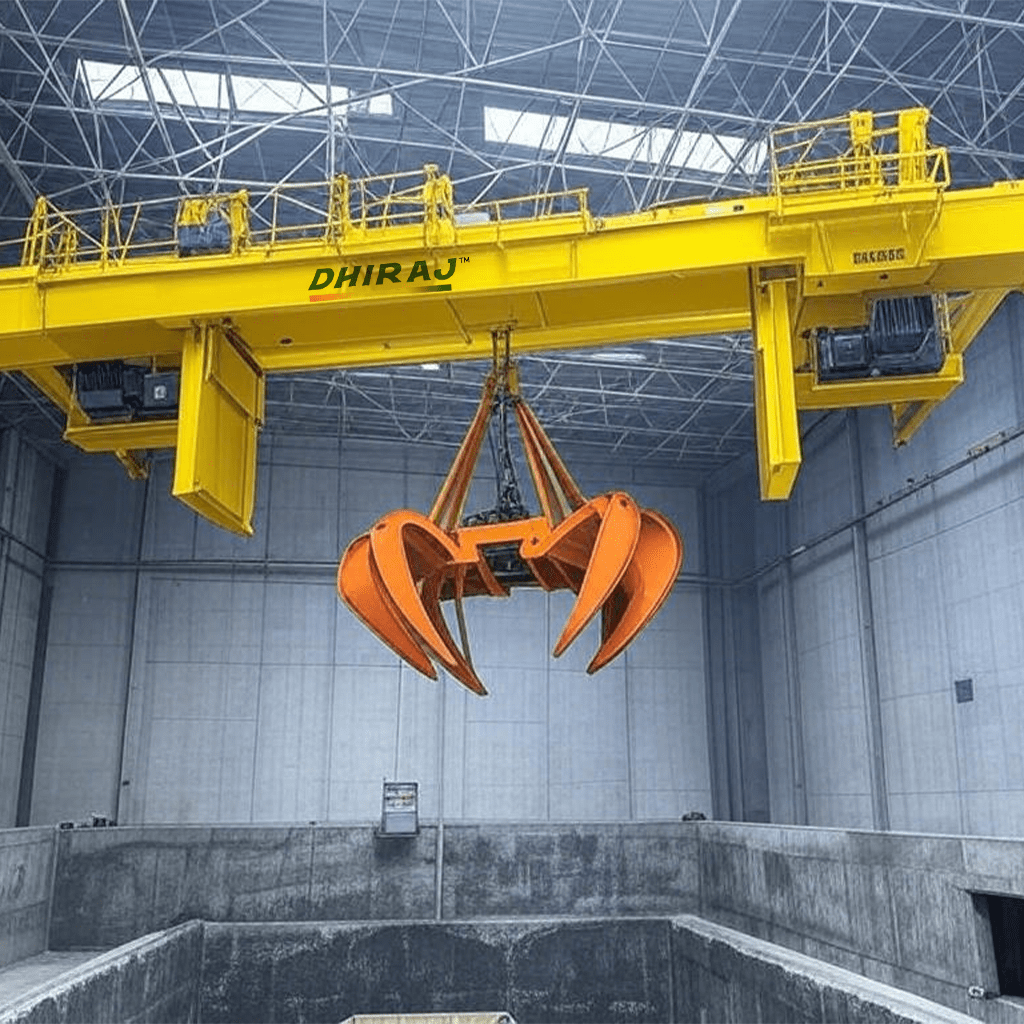
EOT Grab Bucket Crane for bulk material handling.
A purpose-built electric overhead crane with a grab bucket mechanism for moving loose and bulk materials such as coal, sand, gravel, ore, limestone and gypsum. Dhiraj Cranes lists 5 T to 20 T capacity and span/operation up to 30 meters.
 VIEW 01VIEW 02VIEW 03VIEW 04
Designed for the material that ordinary hooks cannot handle efficiently.
Dhiraj Cranes describes its EOT Grab Bucket Crane as an electric overhead crane designed specifically for bulk and loose material handling. The grab bucket opens and closes to collect material and then transports it across the crane operating area.
The current product page specifies 5 T to 20 T capacity and operation up to 30 meters. It positions the crane for warehouses, construction sites, mining and cement plants, where repetitive movement of bulk materials is part of the operation.
The configuration can be customized around operational requirements, including crane arrangement, grab bucket requirements, control systems and other application-specific parameters.
Grab → Lift → Travel → Release
The grab bucket replaces a conventional lifting hook as the primary material-engaging mechanism. It is designed to collect loose material, lift it and move it to the required discharge point.
- Bulk and loose material handling
- Electric overhead travelling operation
- Single or double girder configurations
- Customizable crane design
- Suitable for repetitive handling cycles
Built around continuous bulk handling.
Grab Bucket Mechanism
Purpose-built bucket attachment for loose and bulk materials.
Efficient Material Movement
Electric overhead travel moves bulk material across the operating area.
5–20 T Capacity
Current product-page capacity range for the crane.
Up to 30 m Span
Listed span/operation, subject to final engineering.
Single or Double Girder
Two configurations are listed for different duties.
Low Maintenance Focus
Dhiraj lists low maintenance alongside durability.
Choose the crane architecture around the handling duty.
Single Girder EOT Grab Bucket Crane
The source product page describes this as a compact solution for light to medium-duty bulk material handling where a lighter configuration is suitable.
Compact handling focus →Double Girder EOT Grab Bucket Crane
The double-girder version is described as providing higher capacity and efficiency for heavier-duty applications requiring greater structural capability.
Heavy-duty handling focus →Made for materials that move in bulk.
The numbers at a glance.
These specifications follow the current Dhiraj Cranes product page. Final engineering values should be confirmed against the project requirement before manufacturing.
Application-first engineering
Material type, bulk density, required bucket volume, capacity, span, operating cycle and control arrangement influence the final configuration.
| Capacity Range | 5 T – 20 T |
|---|---|
| Span / Operation | Up to 30 Meters |
| Lifting Mechanism | Grab Bucket |
| Type | Single Girder, Double Girder |
| Material | Mild Steel, Stainless Steel |
| Power Supply | Electric Powered |
| Design | Customizable |
| Speed | Customizable based on requirements |
| Trolley Option | With / Without Trolley |
| Operation | Electric Overhead |
| Application | Warehouses, Construction, Mining, Cement Plants |
| Maintenance | Low Maintenance |
A simple cycle, engineered for repetition.
Move crane and bucket to the collection point.
Position the grab around the loose material.
Close the bucket and raise the material.
Move the load to the discharge area.
Open the bucket and discharge material.
Controlled movement matters.
The source product information emphasizes safety, precision, durability and reliable operation. A grab bucket crane should be engineered around the material, load characteristics, duty cycle, environment and travel path.
Confirm material type, bulk density, capacity, bucket configuration, lifting height, span, operating frequency, controls and structural conditions before finalizing the system.
Turn repetitive bulk handling into a defined process.
A dedicated grab bucket crane can create a consistent lifting and transfer process for loose materials while reducing reliance on manual handling.
Dhiraj positions its grab bucket cranes around durability, efficiency, customization, safety and low-maintenance operation.
From mining yards to cement plants.
Mining Areas
Bulk coal, ore and mineral handling.
Cement Plants
Limestone, gypsum and loose raw materials.
Power Plants
Bulk fuel and material-handling processes.
Steel Plants
Scrap, coal and bulk material handling.
Ports
Controlled overhead bulk material transfer.
Storage Yards
Movement between storage and processing points.
The bucket is only one part of the system.
A reliable grab bucket crane depends on the relationship between crane structure, hoisting arrangement, grab mechanism, travel system, controls and the material being handled.
The final configuration should be developed around the operating cycle and material characteristics rather than choosing a bucket size or crane capacity in isolation.
Project inputs to prepare
- Material type and bulk density
- Maximum required load
- Required span and lifting height
- Grab bucket capacity / configuration
- Operating cycle and frequency
- Indoor or outdoor environment
- Preferred control arrangement
- Structural provisions
From bulk-handling requirement to installed crane.
Start with the material and handling cycle, then develop the crane around capacity, span, grab arrangement, controls and site conditions.
Study material, load and process.
Define crane and grab arrangement.
Develop project-specific details.
Manufacture the crane system.
Installation, commissioning and after-sales needs.
Reliable bulk handling depends on planned care.
Routine inspection
Inspect structure, end carriages, wheels, hoisting mechanism, grab bucket, ropes/chains where applicable, brakes, motors, electrical components and controls according to documentation and the site maintenance program.
Unusual noise, vibration, visible damage or changed operating behaviour should be investigated before continued use.
Grab bucket care
The grab bucket directly contacts handled material. Moving parts, attachment points and wear areas should be inspected as part of the maintenance routine.
Intervals should follow supplied equipment documentation and applicable site requirements.
Is an EOT Grab Bucket Crane the right fit?
Consider one when:
- Material is loose or bulk in nature.
- Repetitive grabbing and transfer is required.
- Coal, sand, gravel, ore, limestone, gypsum or scrap is handled.
- The operation benefits from overhead travel.
- Manual bulk handling needs to be reduced.
Confirm before ordering:
- Material and bulk density.
- Maximum load and bucket capacity.
- Span, lifting height and travel path.
- Operating frequency and duty.
- Power and control requirements.
- Site and structural conditions.
EOT Grab Bucket Crane — practical answers.
What is an EOT Grab Bucket Crane?
It is an electric overhead travelling crane designed for bulk and loose material handling using a grab bucket attachment that opens and closes to collect material.
What capacity is available?
The current Dhiraj product page lists 5 T to 20 T.
What is the maximum span?
The current product page specifies up to 30 meters span/operation.
What materials can it handle?
Coal, sand, gravel, ore, limestone, gypsum, waste and other loose bulk materials are listed across Dhiraj product information.
What types are available?
Single Girder and Double Girder EOT Grab Bucket Crane configurations are listed.
Which industries use them?
Warehouses, construction, mining and cement plants are listed on the current product page; other Dhiraj industry pages also reference steel, power and port applications.
Can the crane be customized?
Yes. Dhiraj states that capacity, span, grab bucket size, control systems and crane configuration can be customized.
Is it electric?
Yes. The specification identifies electric power and electric overhead operation.
Does it require high maintenance?
The product page lists low maintenance; actual requirements depend on duty, environment and configuration.
Engineering the handling system around the material.
The purpose of a grab bucket crane is not simply to lift. It is to create a repeatable bulk-material movement process. The right configuration depends on material, capacity, working area, cycle frequency, grab arrangement and environment.
Application Study
Understand material and handling frequency.
Capacity Planning
Match crane and grab configuration to duty.
Custom Design
Develop span, height, bucket and control arrangement.
Manufacturing
Prepare the system around engineering requirements.
Installation
Plan site installation and commissioning.
After-Sales
Support maintenance and service needs.
When the material is loose, the lifting system should be built around the material.
An EOT Grab Bucket Crane provides a dedicated overhead solution for repetitive bulk-material handling. With a grab bucket mechanism, electric operation and configurable crane architecture, it can be developed for applications where coal, sand, gravel, ore, limestone, gypsum, scrap and similar loose materials need to be moved efficiently.
The current Dhiraj product page lists 5 T to 20 T capacity and span/operation up to 30 meters. Final values and configuration should always be confirmed against the actual application and engineering requirement.
Have a bulk-handling requirement?
Share the material type, required capacity, span, lifting height and handling cycle. Dhiraj Cranes can discuss an EOT Grab Bucket Crane configuration around your application.