Lift more.
Use less headroom.
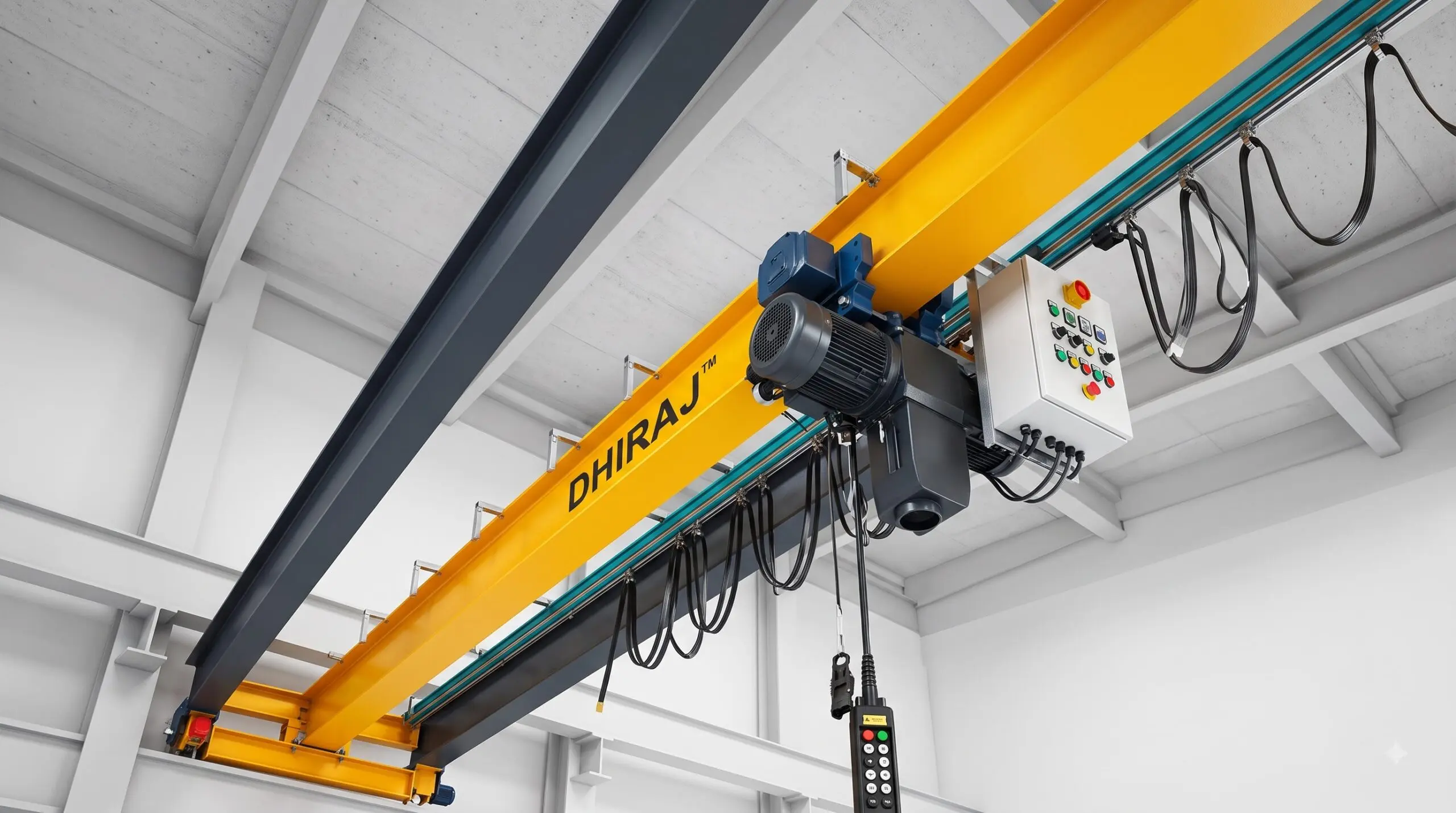
Dhiraj Single Girder – Underslung Cranes are designed for restricted headroom and facilities where conventional floor-supported runway arrangements are difficult to accommodate. The crane travels beneath the overhead runway structure, helping preserve usable floor space.
When the building is the constraint, the crane should adapt to it.
The current Dhiraj product page positions this crane for low-headroom operations, restricted space and situations where floor-mounted runway columns are not feasible. citeturn0view0
Move the crane above the floor — not the floor around the crane.
The underslung system is mounted beneath an overhead runway structure and travels along the bottom flange of beams. This arrangement is presented by Dhiraj for compact facilities where space optimization and lifting height are important.
Unlike top-running systems, the crane travels beneath the beam flange of the overhead runway structure. citeturn0view0
The product overview highlights restricted space and structural limitations as key reasons to consider the underslung configuration.
Warehouses, workshops, machine shops, assembly lines and industrial plants are listed applications. citeturn0view0
A different crane layout for a different building condition.
Clean engineering-style visual: overhead runway, bottom-flange travel, single bridge girder, trolley/hoist and hook.
The runway is positioned above the crane, allowing the bridge system to operate beneath it.
The crane travels along the bottom flange of the overhead beams — the defining feature of the underslung arrangement.
A single bridge girder spans the working area and carries the trolley and lifting system.
The electric hoisting arrangement raises and lowers the load while the trolley positions it.
Six practical advantages of the configuration.
Low-Headroom Operation
Designed for facilities where vertical clearance is restricted and lifting height matters.
No Floor Runway Columns
The source page specifically positions it where floor-mounted runway columns are not feasible.
Smooth Motorized Movement
Motorized travel along the bottom flange supports controlled movement.
Easy Installation
The product page describes installation without floor supports.
Tailored Specifications
Tailored lifting specifications and control options are available.
Low-Maintenance Focus
The specification describes low maintenance and durable performance.
Where the underslung architecture fits.
The current page lists warehouses, machine shops/workshops, assembly lines and industrial plants. citeturn0view0
Move goods while keeping floor areas clear of runway supports.
Material movement in compact and congested work areas.
Overhead lifting for equipment and routine material handling.
Continuous material flow where space optimization matters.
Equipment and raw-material handling in low-headroom areas.
Overhead movement for compact production layouts.
Controlled overhead positioning of machinery and equipment.
For layouts where conventional top-running systems are difficult.
Electric or manual — selected around the application.
The current source identifies a Single Girder Electric Underslung Crane and a Manual Underslung Crane. citeturn0view0
Single Girder Electric Underslung
Suitable for light to moderate material handling, with precision and reduced structural load.
Manual Underslung Crane
Intended for light-duty applications or areas with limited power access, using manual gear operation.
Application-Based Configuration
Selection can be aligned with load, span, headroom, power availability and control preference.
Your real crane views can sit beside the engineering story.
Replace the five image placeholders with your final product photographs or renders.
The numbers behind the configuration.
Specifications below follow the current Dhiraj product page. citeturn0view0
The mounting difference changes how the crane uses the building.
The current Dhiraj FAQ describes underslung travel beneath the beam flange and top-running travel above runway beams. citeturn0view0
From building constraint to working lifting system.
Align the crane with the facility, load and operating environment.
Understand the Facility
Review headroom, runway structure, floor space, load and working area.
Define Configuration
Set capacity, span, lifting height, hoist and controls.
Build & Test
Manufacturing and testing around the defined engineering requirements.
Install & Support
Installation, commissioning and after-sales support complete the cycle.
Why the underslung concept can make a difficult building easier to work with.
Making use of the overhead structure
The defining concept is to suspend the crane beneath the overhead runway arrangement, useful where a suitable supporting structure exists and floor runway columns are undesirable.
Protecting usable floor space
The source page positions the system without floor-mounted runway columns, helping preserve working floor area for production, storage or assembly.
Maximizing lifting height
The current FAQ describes the arrangement as maximizing vertical lifting height by running beneath the beam structure.
Light to medium-duty handling
Dhiraj states 0.5 T to 20 T and positions the crane for light to medium loads in workshops, warehouses, assembly lines and industrial plants.
Control flexibility
Pendant, radio remote and cabin control options are listed in the current product page.
Structural-limit focused
The product overview explicitly highlights restricted space and structural limitations, making application-led engineering important.
Built for practical industrial use.
The current source describes low maintenance, durable performance, rigorous testing and nationwide service support. citeturn0view0
Runway & Travel Inspection
Review travel components and runway conditions according to the crane maintenance plan.
Hoist & Hook Checks
Inspect lifting components and hook assembly as part of planned maintenance.
Electrical Checks
Review controls, protection, wiring and electrical components during servicing.
Preventive Maintenance
Planned inspection helps identify wear early and support availability.
Overload Protection
The listed specification includes an IP55 control panel with overload protection.
After-Sales Support
Dhiraj states nationwide service support for its underslung crane solutions.
Single Girder Underslung Crane — frequently asked questions.
What is a Single Girder Underslung Crane?
It is an underslung EOT crane mounted beneath an overhead runway structure and travelling along the bottom flange of supporting beams.
What capacity is available?
The current Dhiraj product page states 0.5 T to 20 T.
What span is available?
The current specification states up to 30 meters.
Is it suitable for low-headroom facilities?
Yes. The product page specifically positions it for low-headroom and space-constrained facilities.
Does it need floor-mounted runway columns?
The source positions it for situations where floor-mounted runway columns are not feasible.
How does it travel?
It travels beneath the runway structure along the bottom flange using the specified travel mechanism.
What control options are available?
Pendant, radio remote and cabin control are listed.
What applications are listed?
Warehouses, machine shops/workshops, assembly lines and industrial plants.
Is a manual version available?
Yes. The current page lists a Manual Underslung Crane for light-duty applications or limited-power areas.
Can it be customized?
Yes. The source states tailored lifting specifications and customizable lifting height and operating configurations.
Your building has the limitation. Your crane doesn't have to.
Share capacity, span, available headroom, runway arrangement and application. Dhiraj Cranes can help define a suitable Single Girder Underslung Crane configuration.